Showing posts with label community. Show all posts

Saturday, 2 November 2013

Searching for the North at Bishopthorpe

Every month or so, an e-newsletter titled 'Spirit Level' pops into my Inbox.  It's complied by a lady called Janet who represents the Churches Regional Council (CRC), a body originally set up by the Yorkshire and Humberside Regional Development Agency.  The dozen or so former RDAs have been phased out as such, but CRC marches on.  Spirit Level is a fascinating digest of church activities.  I've attended several events and downloaded some excellent material from its content and links. 

The October one caught my eye:   A day conference for mission practitioners, church leaders, theologians and missiologists to reflect together; What is distinctive about the North of England?  What might be a proper and fruitful relationship between the North and South for the mission of God in England?  Is there a Northern gospel?  The date was free, the price modest, and it was at Bishopthorpe Palace, York, a quick hour's train journey away, so I booked. 

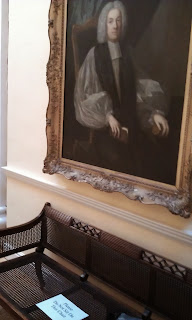
There must have been worst places to be on the day.  The morning sun was clear and bright, and the mature trees in the Palace grounds flushed with autumn colours.  Along the gravel approach, through the arch, up the terrace steps, and enter by the front doors (not the generally used Reception) to collect my badge.  It's the paintings, or should I say portraits, that set the tone: all clerics one imagines of high status - in varying poses and vintages of dress.   We were ushered into the State Hall.  I counted fourteen portraits high around the walls, then amazing mouldings reaching the ceiling.  Through the large sash windows, the Ouse flowed wide, fast and dark brown along the rear garden terrace.  Most of the delegates were in clerical dress of contemporary mode.   "I feel like a lion in a den of Daniels," I observed to Gavin, our facilitator for the day.
The housekeeping announcements introduced us to a beautiful brass bell suspended in a wooden frame to be rung as a fire alarm.  Malcolm, the Archbishop's Chief of Staff, welcomed us and led the opening prayers.  He apologised that the Archbish was unable to be here - away in Canada.  Then we had our first morning plenary session: a set of compelling statistics presented by Kate Pickett, professor of epidemiology at York.  (You can see the presentation, done by her colleague and co-author on http://www.ted.com/talks/richard_wilkinson.html).  The studies include aspects of health, quality of life, social capital compared across 23 counties.  Her basic conclusion was that inequality in incomes causes more harm than low incomes (per se).  And the relevance to the North of England was that when things start to get bad, they get worse faster and more pronounced for poorer regions.  Kate invited a Christian response of speaking out against destructive inequality.

Over coffee, I met several other folks from Sheffield, though the total catchment ran for Newcastle to Nottingham, and across both sides of the Pennines.  Session two was the turn of Steven Cross, Bishop of Sheffield.  He spoke of two strands of analysis at work in the diocesan churches: first, congregations know the gospel but need guidance on how to launch mission.  Two: churchgoers aren't clear on the gospel, and that's where we need to start evangelism efforts.  As for the North - he described the narrative as 'tragic, rather than romantic', and that may be some distinctive.  Bishop Steven also provided a necessary balance to the earlier session, by reminding us that our salvation isn't economic, but from the Kingdom of Heaven.

Just before the lunch break, Gavin introduced how the afternoon whole session would run.  The programme said 'open space technology' - we we intrigued.  A bunch of upturned table tops were lined the front, ready for sticking up flipchart sheets.  "Here's how it goes," Gavin explained (I later learnt these rules nare specially suitable for theological reflection - or TR). "First, we agree our topics - anything that's been stirred up this morning, or that we felt was missed.  Second, we accept that in the gathering we have all the needed talent and experience to make real contributions.  Third, the law of two feet - if we're not making progress in the present group, we move to another."  He waved a marker pen, "So, who's got the first topic?"  A lady vicar sprang to her feet and spoke about a recent announcement that Northern towns in the grip of economic decline should be left to die.  "How do we bring hope and meaning in places like this?"  "You can lead group 1 on that." Gavin scribbled on the flipchart, nodding.  Having collected eight groups, we headed for lunch.

Two lovely sister in grey habits were gliding between adjacent admin offices.  I asked them if they live in, and explained my community background.  I bumped into two guys from the University of Carlisle, who similarly were engaged in a community experiment.  Lunch was sausage casserole and mash, followed by apple crumble.  And there were seconds.  "I bet you wouldn't get that if we were meeting in Winchester," I commented to three Methodists at the long oak table.  I skipped the stroll round the gardens that others had opted for, so I could familiarise myself with the format for the groups.  Fresh from our own trustee training session, I wanted to focus on key points.

"I thought Hull had low church attendance because they'd never heard the gospel," the lady vicar related.  "I took a funeral of a family man in his early 40s, and afterwards went to see his wife.  'Is there anything I can do to help...?' She replied, 'I've got rats in the garden and mice in the house; there's water running down the walls.  My two boys are up in court tomorrow and my daughter was brought home - found in a alley.  And I've had no money since the funeral.  Where would you like to start?'"  The tragic narrative.  My group (held later) concluded that sincere worship, and sharing testimonies of experiences with God created an authentic spirituality.  Gavin gathered up the flipcharted contributions, and hinted that another conference may follow.  They need it: mission hasn't really penetrated average parish consciousness.

Back at York station, I had a coffee with Joe, my grisly friend who use to come to our Jesus Centre every week.  "Had a holiday then, Joe?"  "A day at Scarborough."  "Well, York itself isn't such a bad place," I consoled.   "I stay out of the way," he muttered.  A month back I happened to be passing the Minster.  'Here,' this Yank calls over, 'Just to be clear - is this pre-war?'  I glared, an' said, 'It's pre-America.'  I just stay out of the way." 

Sunday, 27 October 2013

Sweeny4

Phil walked in with a smart new haircut.  This was rare.  He's one of those characters who generally seems to have taken a knife and fork to his hair whilst leaning over the bathroom sink, and then finished it off with a three-week old razor, just to give his ears a bit more airspace.  His glasses too, look as though they're held together with sellotape.  So presenting himself conspicuously tidily was worth a compliment.  "I had it done free," he stated, "as a model for a trainee. Just down Eccleshall Road". 

He had me hooked.  Through my community years, I've engaged with haircutting from two directions.  First, where I could get done, traditionally free, and by someone who had half an idea.  And then learning to give them, both with scissors and an electric trimmer, as a small contribution to my brethren's welfare.  (Nape hair is the great amateurish give-away; I have a thing about it.)  But when I moved to Leeds, I gave this up as one job too many in a busy life, and because David (living with us) was pretty good.  He was grateful to inherit my kit.  And I'd also conceded that popping down from the Jesus Centre to the walk-in emporium at the bottom of the Moor for a pensioners afternoon £3 concessionary was just a no-brainer.  Free, at a professional barbers, sounded too good not to explore. 

Now this was May, when winter hadn't really packed up and gone, and the forecast was grim (you remember the miserable Whitsun Bank Holiday?).  But I was due for two weeks in India in September, and a bit of forward thinking could have me ready with a buzz cut for the guaranteed high temperatures, whatever the English summer may bring in-between.  I rang Alex, on the number advertised in the shop window: "A number 4?"  "Yes; sure.  Come down after 1.30pm."  I don't understand why I was surprised that Alex was a lady.

I was ushered to a seat at the far end and introduced to Christian.  "Number 4 all over?" Alex enquired.  "It'll seem short."  True, I had grown quite a thatch since my last haircut.  It had been particularly stylish, swept up from one side with a blower.   It hadn't stayed looking tidy for much more than a couple of weeks.   Christian was nervous.  Maybe me pulling out my hearing aids hadn't helped.  "Did I drag you away from anything important?" he politely enquired.   "Nah, I do some charity work, y'know, down at the Jesus Centre."  My red cross was unavoidably conspicuous.  "Mmm,"  he replied. "I met Nayth and Chris last year.  An' I know Viv.  They came round to our place one night.  An' Viv keeps inviting me round for tea."  Wow, I thought, how did this happen?

We chatted on and he buzzed away, still somewhat hesitantly.  Alex came over and gave him some tips on grading.  I nodded at my beard.  "You can have a go at that, if it's part of your practise."   We agreed on a regime, and out came a new smaller electric trimmer.  Then we settled that my ears needed attacking.  Alex did one; Christian the other.  "Sorry," she broke in. "This is all taking an awful long time.  Can I offer you a drink or something?"  I was gratified, but declined.  She leaned forward.  "Now, what are we going to do about the eyebrows?"  Since everything else had been pruned like roses in February, I had to concede.   "I love doing eyebrows!" she glowed, like a gourmand who's saved the best til last, and is about to indulge.  I smiled, and suspected that poor Christian wasn't going to get a look-in on this.  I looked in the mirror.  Yes, this was at least as svelte as Phil.

Four weeks before the Multiply India trip I went down again.  Christian was nowhere to be seen.  Another trainee, who was at the end of her apprenticeship, produced a confident and proficient job in half the time.  "About how long would you expect a cut like this to last?" I ventured.  "Oh, come back in another couple of months."  I put a reminder in my phone diary.

The third visit, Christian was my man again.  We chatted some more about the guys he'd met, and I invited him to Praise Day, where they'd be sure to be there.  He was grateful that Viv kept in touch.  The shop's hours are set to catch the customers' convenience, so he's not likely to get a lot of free evenings.  Then he mentioned that he was due to be off to India for a holiday.  (He also said he wished he could grow a decent beard.)  I told Alex he'd noticeably grown in confidence.  This time I remembered to give him a tip, too.  Nice one.

Saturday, 26 October 2013

Trustee Training

We're working hard on succession for our church trusts and business boards.  For sure, we know that the rising generation will not be prepared to become a fresh pair of legs under an old burden.  They must have a say in shaping for the future.  So, much was to hang on the inter-generational training day that Mick conceived after conversations with our Birmingham-based charity lawyers, Anthony Collins. 

Mick puts a lot into shaping our culture, and it's more that cosmetic.  Well in advance we received an informative programme brief, and I got a schedule of table groups.  The key business players and central office teams were under orders to make themselves - and other people invited - available for the day.  Viv and I drove down together.  He's been 'in attendance' at Charitable Trust (JACT) meetings for a year or so.  It's part of his Professional Development Group programme experience - another initiative running to deliver more sustained input to significant employees going forward into management. 

Cornhill Kings Room was purposefully laid out for the job, and Farhad, Mick's PA, was busy.  Simon, our 'facilitator' for the day, stepped forward and made introductions.  It turned out that he attends the Methodist Church where Mick's family were members, and Mary and I married.  As the 50-plus delegates straggled in, Simon repeated the process.  This, too, was more than cosmetic.  It became apparent during the day that he'd remembered an impressive number of names. 

I was due to lead a group from the Church Life Trust, the top-level instrument for our Regions' organisation.  This would be a new challenge, as I'm most embedded in JACT (the Jesus Centres charity) and our Group businesses board.  Life Trust embraces Multiply, and I wondered if this was how I qualified.  In the event, owing to a few absences, I did end up with a JACT group.  It was just three of us: Jayne and Stevo, from Northampton Jesus Centre, and me.

Simon briefly previewed the day's programme, designed to introduce us into running effective meetings.  The he got us straight into an icebreaker activity.  We had to draw - or write - on a post-it note, what fired up our energy in the work situation and away from it.  Then we had to mingle round and explain it to as many people as possible.  I wrote Research on both halves.  This provoked a snort of derision from Stevo, which wasn't a promising start.

Simon's first session was aimed at challenging mindsets that say the most important component in a meeting is the tasks in hand.  No, it's the people, in all their diversity, ability and experience.  He bobbed from flipchart board to flipchart board (there were three tactically placed at different points in the room), and back to his projector.  Then each table had a go at breaking down the question "what's the big issue facing us" into as many contributions as we could harvest, followed by a synthesis to render all the material into one or two key points.  It was a serious challenge.  In the end, Simon sent round 'flying moderators' to slash through the excess where groups were struggling with the consolidation process.  Brilliant.

Our flipcharts were scooped up for Simon's secretary to compile our final offerings, so that after the coffee break we had the results neatly on the screen.  This had all relied largely on in-house focus.  Session two went the other way - producing an analysis of major environmental factors.  Our table was given the one word the Economy.  This had to be exploded into a set of concrete objectives, by which our Jesus Centres could respond to prevailing circumstances, and plan ahead to remain relevant as trends moved forward.  Over lunch, all this was typed up, too.
After the lunch break, Stevo and I took a stroll.  We exchanged notes on Myanmar - where his parents have just landed for six months' church work, and our community initiative in Northampton's eastern development, where he lives with his family.

Now it was time to tackle techniques for handling change processes, and to demystify buzzwords like brainstorm.  More contributions, more lists; flipchart sheets everywhere.  The activities bounced along, followed by cheers for those who had worked hardest at scribbling down everything.   Simon remained firmly in control of the clock, whilst thanking us for every contribution, and somehow managing to turn it to use.  In the finale, the room broke into two, and we competed for even the wackiest suggestions to make meetings more effective. 

"I've no idea how I'll use all this in the meetings as we have them," Jen commented afterwards.  No, I can't see us deliberating while remaining standing up, or taking the agenda in reverse order.  But it was a glimpse of the fact that we could, if so inclined.  

Friday, 13 September 2013

Multiply India Visit Day Eight, Sept 10 - Thoughts

I attempted a bit more sleep, as I'd be travelling overnight from Kolkata to Bangkok, then on to Yangon.  As the morning was free (apart from the perennial packing), and not a soul was stirring outside because of the State BANDH, I sat down with a mug of tea and engaged in some reflection.  What had the week so far revealed?

First, I thought about the models of community living we'd experienced.  In Bangalore, there was Daniel and Betty Edwin's 'open house' or 'home-from-home' in the apartment adjacent to his church building.  In addition to a wheelchair-bound grandma, they were hosting an older brother who was getting on his feet in God.  Various church pastors and evangelists (we'd say leaders), dropped by from the ministry's outlying works.  As in New Testament days, where travel is troublesome, such hospitality is essential. The two conference delegates from Andhra Pradesh had travelled 30 hours by train to attend.  Here, in India, the evening is a key time to find people around.  Cake and chai, and a pot of rice are always on offer.

Then there's Colney's (or, rather his father's) Mission Home in Aizawl.  We'd only seen about half the overall residents from the total complex at the evening prayer times.  In the whole compound there's a large dormitory of children, too - I believe Colney's mentioned a total of 70 souls.  Two young women attend to the household domestic duties.  Colney's father (aged 79) sits at a small table outside the ground floor worship/main hall, holding a daily 'surgery'.  Financially, they're thrown together by necessity, and everyone's industriously engaged.  On Monday morning I watched a boy about eight years old plying backwards and forwards from the compound's own well, filling two large green watering cans, and tottering from apartment to apartment topping up supplies.  There's an attempt at homegrown sufficiency, or at least supplement, with chicken, ducks and geese, and a large poly-tunnel.  Again, necessity, not 'lifestyle'.  "God's little acre" would be an appropriate term.  Somehow, everyone had found a place, and accepted their part's responsibility.

Second, I was struck by Colney insisting that any evangelism material for Wednesday's "Church on the Streets" should be in Mizo.  "English speaking, Christianity and Western Culture are synonymous," he'd explained.  "And Moslems, Hindus and Buddhists react against it."  In a no-holds-barred multicultural setting, as India, there remains an appropriate recognition - even celebration - of some aspects of diverse culture.  I suspect we in UK 'new churches' have blundered around unhelpfully with immigrants and second generation populations, because we don't have a missionary-sending ethos. 

True, we'd managed my teaching yesterday without translation.  But Colney had largely spoken in Mizo, and three three local music groups had thrown in a mixture.  In Bangalore, we'd had entire translation into Tamil or Kerala (Daniel E's wife, Betty, had done this for the Nathan and Sam in the Thursday concert.)  They say you need your own tongue to deepen your intimacy/relationship with God.  Sam commented how difficult it was to achieve good communication when you couldn't read the body language nuances - and he'd been trying impressively.

Third, I'd found a refreshing rhythm to life.  I can't say relaxed, because the daily round of working, feeding and keeping up with relationships is a bigger slice of peoples' energies than in UK.  But when we, as a church, are seeking a return to more time for people, there's something going on here to note.  True, the tropics days work to a pretty unvarying daylight and darkness pattern.  But, blessed with the convenience of lighting and goods to improve things, we've jumbled up, overfilled and scrambled the connection (and connectedness) of daily life.  You just set your own agenda, and touch with others at the margins.

For example, again in Colney's Mission Home, there was little obvious organising - it was an implicit operation of life.  I find it difficult to settle on one change that would reconstruct this kind of quiet vitality.  Perhaps Mick's team exploring a theology of time will do better.

Fourth comes the open-heartedness and open-handedness to many servants of God.  I've found a response based on the simple expression of need that fellow-labourers can empathise with, and will strive to support in.  Is this because many pastors, evangelists and workers operate near the breadline and on the limit of resources as matter of course, and it's just an unquestioned 'part of the territory'?  They don't hide their insecurity and dilemmas.  They're often in emergency.  I sense that many leaders know they gain a blessing from giving when faced with such knowledge.  It would be unbrotherly to fail to engage in prayer, seek to help practically and with moral support, and use connections, when it's available for you to do this and so to partner with others.  I found little evidence of scrutiny and cross-questioning, though a discernment of motives and genuineness certainly applies.  We need to note this as our Multiply exec and Regional funds get increasing contact with a variety of global ministries.  The right stance should be to celebrate the rich texture of God's word and grace outworked in trying circumstances.

Fifth, is fervent prayer, and a confidence that God's hand is on lives, and that's best.  Colney spoke of the Christian North Eastern States being jammed between Buddhist Myanmar, Moslem Banglasesh, and Hindu north India.  But it's not just leader-speak.  Average saints display a freshness that the distinctive Christian way is unquestionably and demonstrably right, clean, true, genuine, to be imitated, influential and embraced where possible.  It will lead to many blessings now and in the future; personally, for family and nation, and conclusively won't be worsted.  So, prayer was expressed along the lines of God's goodness and greatness, not life's problems or some incompleteness.

Wednesday, 20 February 2013

Five Hours at Darvell

Bernard, from the Bruderhof in Robertsbridge, sent Huw an email inviting some leaders to visit.  This followed several rounds of contact between our members and theirs.  The Strong Light saints have been joining with Bruderhof members when evangelising in Luton.  Some of our Living Light and Living Stones J Generation went to visit Roberstbridge for a weekend late last year.  Huw and Mick liked the opportunity to link in a visit to the new sea-front Abundant Grace house in Brighton.

So Wednesday found me catching a train to Northampton to meet up with them, and Kelly, for a drive down together.  On the M25 we listened to a video of Justin Welby visiting Trent Vineyard, which Mick's brother had recommended.  The Brighton saints settled us into their first floor lounge.  It boasts (in estate agent language) an enviable and unrivalled panoramic view over the beach.  We had tasty home-cooked pizza for supper, while Len rehearsed the trials and joys of moving from their previous larger property in Seaford. 

Next morning was bright and cold, with a sharp wind.  I ventured along the Prom; the few puddles were frozen over.  Len timed our journey to Roberstbridge well, and we arrived a few minutes before 10am.  Bernard's father, David, is Guest Warden, and showed us up to Felix's and Emma's apartment.  There are 320 members and guests in residence, in five or six very large houses.  The Darvell site started as a redundant tuberculosis hospital.  Buildings have been added in the last 50 years to suit the Bruderhof's growing needs.  There's a primary school, modern wood-workshop, etc.  Their dozen or so cars are parked at the entrance, making the 80 acre site virtually a pedestrian zone. 

Emma served us delicious home-made apple and cinnamon cake.  Johnny, Bishop and Servant of the Word, joined us to explain their background and practice.  After four years in compilation, last year the Bruderhof worldwide published a statement of faith, Foundations, which Johnny summarised.  There was lots for which we needed no introduction: covenant, common purse, simplicity, pastoral leadership, shared work, temporary guests.  However, one obvious difference is that they haven't planted church congregations, and don't run anything equivalent to Jesus Centres.  Think Jesus Fellowship in 1983, and you've got a fair comparison.  They have a deep pastoral care and yet prophetic lifestyle.  Just before 12.00, David suggested we took a walk ahead of lunch. 

Kelly had spotted diggers a work at two points on the site: one to house a new biomass boiler system, and the other to replace a residence block that was progressively being demolished.  "What's this place?" I asked David.  "The dining room."  Sure enough, we walked into a huge modern hall, with views over the fields on three sides.  The uniform lines of tables and chairs were set out with equally matched cutlery and plates.  Without a signal, the tables filled up.  A voice from the PA bade us welcome.  The diners tended to sit in family groups, and conversation was muted.  While we ate, children from the school related the highlights of their previous day's visit to a local aquarium.  They began with sincere thanks for the adults arranging this field-trip.  As an exercise in burying self-consciousness in front of 300 people, it was excellent.  I didn't realise a puffer fish can only inflate nine times because of the strain on its heart. 

After lunch we tramped round the fields they cultivate for self-sufficiency, and looked into the school.  David commented that neighbours scrutinise everything: erect a tool shed and the complaints pour in.   In the workshop, Oliver explained the manufacture and assembly process, and how they rota the jobs.  Although the workshop pays its way, with no wages, or congregations or Jesus Centres to support, their business ventures are held well within the Bruderhof's balance of life.  They've chosen to be self-supporting from cradle to grave, so need this means to earn their keep.  I took some photos in the workshop showroom; they were for Jack, but I felt a little awkward. 

Back for a cup of tea before we left, I asked Emma about her experience.  She spoke of keeping the covenant living by daily resolving misunderstandings or tensions that arise.  Beautiful.  As we parted, I commended Felix on his name: he truly has a sunny disposition.

The four of us came away with different impressions.  Mick loved their honour for all members, including the children.  Huw saw warnings how the Holy Spirit's urge to move on could be lost.  Kelly valued the spontaneity and ownership of decision-making, and flexibility of programme.  I felt that nobody coming into leadership in Jesus Fellowship in the last 20 years could understand how this lifestyle formed us, and how different we have subsequently emerged. 

Len told me since, that Darvell regularly hold open days.  Although they don't encourage "sightseers", you'd receive a warm and genuine welcome. 

Thursday, 17 January 2013

Celibacy in the Headlines

So, the spotlight's on celibacy.  Is it a fair deal for Christian gays in committed relationships with ambitions to be a C of E bishop?   We've been practising celibacy for over 30 years, and have found it a fruitful, and even "better", lifestyle choice than marriage (or indecisiveness).  Some people have just got to abandon their anachronistic objections stemming from 1521, stop fighting yesterday's battles, and realise that Protestants have been missing a trick.

We've learnt plenty along the way.  When we teach on this to our Multiply delegates it sends up sparks.  Since often their churches have a problem with Aids widows, there's a glaring contradiction here.   When, in both Africa and India, I've explained celibacy practise, it opens a new possibility for saints who are stuck in a cultural impasse.  I remember it was clearly the case for two lady church workers in Kenya, a single younger man in Rwanda who had no known immediate family, and an Indian evangelist committed to working in unreached villages.

I begin by reviewing prophetic and sacrificial signs known to serious believers.
Marriage: revealing Christ and the church;
Burial (particularly as opposed to cremation) : anticipating bodily resurrection;
Radical sharing: celebrating God's free gift of Eden, the Acts 2 enactment of Jubilee, and looking onwards to the New Earth;
Celibacy: confirming new creation and in the pattern of our eternal heavenly - not natural - relationships.

Then we have three strands of biblical precedents.

The Old Testament: Nazirites, and Isaiah’s Eunuchs

NUMBERS 6:2 "Speak to the Israelites and say to them: `If a man or woman wants to make a special vow, a vow of separation to the LORD as a Nazirite,

ISAIAH 56:3  And let not any eunuch complain, "I am only a dry tree."  4 For this is what the LORD says: "To the eunuchs who keep my Sabbaths, who choose what pleases me and hold fast to my covenant -- 5 to them I will give within my temple and its walls a memorial and a name better than sons and daughters; I will give them an everlasting name that will not be cut off.


The New Testament: Jesus’s Teaching
Marriage, Divorce and Celibacy (Matthew 19:1-13)
No Marriage in the Eternal Kingdom (Luke 20:34-38)
Jesus’ Life, and Followers (Revelation14:4)

MATTHEW 19:10 The disciples said to him, "If this is the situation between a husband and wife, it is better not to marry."  11 Jesus replied, "Not everyone can accept this word, but only those to whom it has been given. 12 For some are eunuchs because they were born that way; others were made that way by men; and others have renounced marriage because of the kingdom of heaven. The one who can accept this should accept it.”

LUKE 20:34  Jesus replied, "The people of this age marry and are given in marriage.  35 But those who are considered worthy of taking part in that age and in the resurrection from the dead will neither marry nor be given in marriage, 36 and they can no longer die; for they are like the angels.  They are God's children, since they are children of the resurrection.


The New Testament: Paul in 1 Corinthians chapter 7
  • marriage is a concession v6
  • he wishes all were like him v7
  • time is short and stressful v29
  • marriage gets in the way v26
  • the world is passing away v31
  • living in undivided devotion to the Lord v39
1 CORINTHIANS 7:32  I would like you to be free from concern.  An unmarried man is concerned about the Lord's affairs--how he can please the Lord.  33 But a married man is concerned about the affairs of this world -- how he can please his wife-- 34 and his interests are divided. An unmarried woman or virgin is concerned about the Lord's affairs: Her aim is to be devoted to the Lord in both body and spirit.

1 CORINTHIANS 7:37  But the man who has settled the matter in his own mind, who is under no compulsion but has control over his own will, and who has made up his mind not to marry the virgin -- this man also does the right thing.  38 So then, he who marries the virgin does right, but he who does not marry her does even better.


We can add the The testimony of the Church
  • Francis of Assisi
  • Thomas a Kempis
  • Mary Slessor (W. Africa)
  • David Brainerd (America);
  • Amy Carmichael (India)
  • Mother Theresa (India)
John Stott, remained unmarried.  He writes that this was through self-control, not gift (charisma).  I understood that this was to leave the possibility open to all, and to prevent pastoral confusion among any for whom it subsequently "didn't work".  His point, on which I agree, is that celibacy creates greater availability/freedom.  By this interpretation, it's not that it's "holier" (though there are hints of that in 1 Corinthians 7, together with Paul's clear use of the word gift).

On to our practise (expanded in "Seven Silver Rings", available from Jesus Fellowship resources).

It often starts with a period of committed singleness - say a year, or three, in which there's freedom to be involved in service with a clear understanding that you're not "available".  Some like to wear a white wrist band.

The stage at which more serious consideration is being given we call probationary celibacy.  Here we include a public acknowledgement that prayer and support is valued as the single person seeks God's will.  This requires good pastoral care, and is confined to those over 21 years age.  It may extend for a year to three or more depending on maturity.  There's no pressure.

I need to explain wearing a silver ring, which is optional.  Many like because it's generally worn on the third finger like an engagement or wedding ring.

We also require that single leaders being recognised as pastors should be clear in their state, i.e. faithfully married or committed celibates.

After the probationary stage, we adopt a full celibacy covenant vow, as this has been asked for by most.  Alternatively some may decline to proceed, and either be content to remain "just single" or consider marriage.  Either way, much has been added to the Kingdom by their love for all and availability to serve.

After a full commitment, the need for psycho-sexual maturing and growth in responsibility remains.  Celibacy is a positive choice for a lifestyle of sacrifice.  It's not an opt-out for those with hang-ups, or hidy-hole for those having experienced relationship breakdowns or confusion in earlier years.  Advice, counselling and friendship is available from a steering group of maturer saints with much experience and lives that most would want to imitate.

The celibate choice is available to the never-married, divorcees and widows alike.  Similarly, although most celibates live in a community house family setting, folks in their own places can make the choice.

Some celibates break their vow.  This is sad, and needs careful pastoral care whilst recognising some loss of prophetic clarity.  to I also need to add that while we actively encourage singleness and celibacy we're not prohibiting marriage (Titus 4:3).

So, it's not imposed, it's not monastic, it's not repressive.  In today's sexually over-obsessed Western culture it's a stinging counterblast.  But its heart is devotion to Jesus and His people.  Isn't that the clergy's calling anyway?

All Bible quotations are from the New International Version